

Industrial manipulation still overwhelmingly runs on two-jaw parallel grippers. One degree of freedom. Open and close. Not because two rigid fingers suit diverse objects, but because a single binary actuator is what a PLC motion planner could coordinate without per-object programming. The Shadow Dexterous Hand had twenty-four degrees of freedom in 2004 and sat in laboratories for twenty years waiting for a control system that could use them. Degree-of-freedom count in every generation of machines was selected at the boundary of what control could make functional. Hardware never had an incentive to push beyond it.
That boundary has now broken. Learned control policies, reinforcement learning in simulation transferred to physical hardware, diffusion models generating whole-body trajectories for forty-plus-joint systems — for the first time, we can generate coherent commands for machines whose mechanical complexity far exceeds anything we have built. High-degree-of-freedom adaptive surfaces, posture-responsive beds, reconfigurable exoskeletons, soft grippers with dozens of controllable zones. No one has designed them, because the incentive did not exist until the control capability arrived.
The hardware engineering for this regime is genuinely underdeveloped. Not missing a few components, but missing the architectural thinking that would make high-degree-of-freedom machines practical to manufacture, power, and maintain. Powertrain design, material selection, transmission architecture: these disciplines optimised for decades within the old envelope, and their solutions do not transfer to machines with fifty or a hundred articulated degrees of freedom. This is the new frontier. Not better software for existing hardware, but new hardware paradigms for the capabilities software has just unlocked.
What a Degree of Freedom Actually Needs
Before proposing architectures, it is worth asking what a single degree of freedom actually requires.
Two things. A mechanism to change state: move it to a new position. And a mechanism to hold state: keep it there. These are distinct physical functions, and conflating them is where the default architecture goes wrong.
An actuator changes state. In the current paradigm, that means an electric motor and everything it carries with it: gearbox, driver, encoder, wiring. Now consider how a typical degree of freedom spends its time. In most systems not in continuous dynamic motion — reconfigurable structures, adaptive surfaces, positioning systems — a degree of freedom moves to a commanded position and then holds it. The duty cycle of active motion is a small fraction of operating time.
If holding state requires continuous power, as it does when the actuator must resist back-driving loads, then every degree of freedom needs its own motor energised at all times, even when static. But if the transmission is self-locking — if the friction angle exceeds the lead angle as in a worm gear or low-pitch lead screw — then holding state is a passive mechanical property. Free of energy cost. Independent of the actuator entirely.
When state holding is passive and state changing is intermittent, a single power source addressed to one degree of freedom at a time is not a compromise. It is the architecture that matches the physics.
This changes the problem. In a system of self-locking degrees of freedom, every mechanism is stable and fixed until power arrives to change its state. Power delivery becomes an event, not a continuous requirement. And if power delivery is an event, it does not need a dedicated source at each degree of freedom. It needs a shared source and a means of routing it.
This is the multiplexing insight. One motor for power. One mechanism for selection. N degrees of freedom. Installed capacity scales with peak load on any single degree of freedom, not with their number, collapsing the utilisation ratio from 1/N to approximately unity.
The path forward is a faster selector, not more motors.
The question is whether this works in practice, what it costs, and where it breaks.
Two Motors, Fifteen Degrees of Freedom
At Water Robotics, we build physically adaptive electromechanical systems: machines with high degrees of freedom that sense and reconfigure in response to the humans using them. Our fifteen-degree-of-freedom robotic chair, Flow, and our forty-six-degree-of-freedom robotic bed, Cama, are products whose functional premise depends on articulation density that one-actuator-per-degree-of-freedom cannot serve sustainably.
Flow's powertrain is built on the separation described above. A single power motor delivers torque through a central transmission. A second motor drives a cam-based selector clutch that routes power to the target degree of freedom. Each transmission is self-locking: with power removed, it holds position passively, indefinitely, under full rated load, at zero energy draw. To reconfigure, the selector engages a degree of freedom, the power motor drives it to the target angle, the selector disengages, and the mechanism locks. The next degree of freedom is then addressed in sequence.
Two motors control fifteen degrees of freedom: one for power, one for selection. Adding degrees of freedom does not change the motor spec.
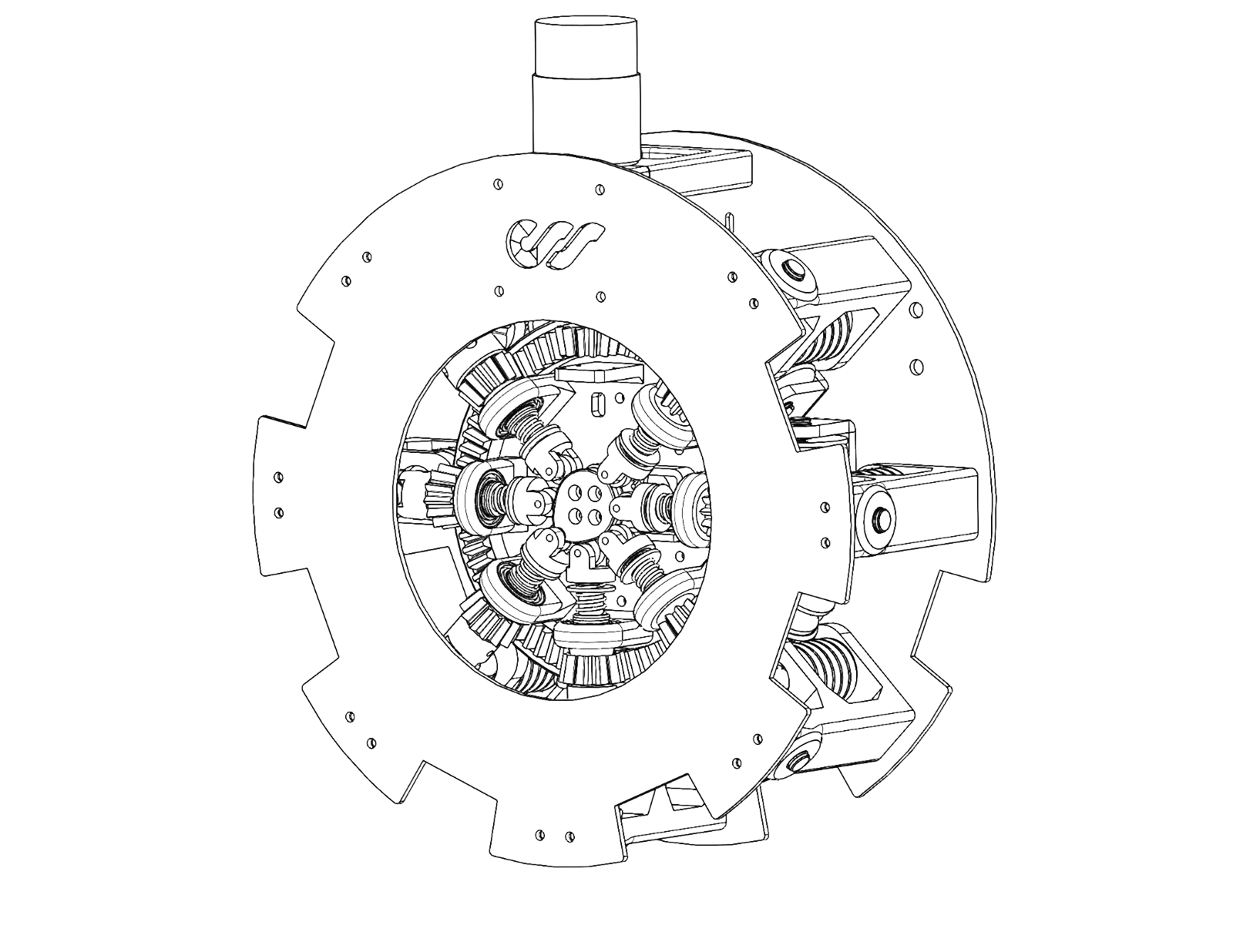
This is not an optimisation target we converged on. It follows from the physics. If only one degree of freedom needs power at any given moment and every other holds for free, there is no physical justification for more than one power source and one selector. A second power motor would enable parallel actuation of two degrees of freedom simultaneously, roughly halving reconfiguration time. But it would also double the installed motor mass, double the driver electronics, and add a second power bus — all to serve a duty cycle in which each degree of freedom is active for a small fraction of operating time. The cost scales linearly. The throughput gain is bounded by how many degrees of freedom actually need to move concurrently, which in a quasi-static adaptive system is almost always one. Removing either motor destroys functionality. Adding a motor buys reconfiguration speed at a cost the duty cycle does not justify.
The domain condition that makes this possible is that Flow and Cama are statically and dynamically stable with both motors off. Every degree of freedom is self-locked. The structure cannot move without power arriving to move it. If the power motor fails, the system freezes in its last-known-good configuration. No surface drops. No mechanism goes limp. The power motor is a single point of reconfiguration failure, not structural failure, and is designed to be field-swappable.
Today, switching between degrees of freedom takes roughly half a second, and it is audibly and perceptibly discrete. The architecture works because Flow and Cama do not need simultaneous multi-degree-of-freedom motion to be functional. Each reconfiguration is a sequence of individual adjustments, and the user's experience integrates them over time. The engineering target is to push switching time below the threshold of human proprioceptive resolution — roughly 100 to 200 milliseconds — at which point sequential actuation becomes perceptually indistinguishable from simultaneous.
The architecture stays. The component evolves.
Why Multiplexing: The Motor Is the Reason
The multiplexing architecture is not a universal law of powertrain design. It is a consequence of what an electric motor is. A motor is a discrete object that replicates its full bill of materials at every joint it occupies. At six degrees of freedom, that scales. At forty-six, it does not. The architecture follows from the actuator's form.
The closest analogy is the electrical power grid: centralised generation, switched distribution, loads that draw only when active. What we are doing is the same operation applied to mechanical power. Centralised torque at a single motor, switched distribution through a selector, and self-locking degrees of freedom that draw only during reconfiguration.
The biological contrast
Now consider the converse. If the actuator were fundamentally different — low-mass, low-cost, inherently position-holding, trivially integrated — then distributing one at every degree of freedom might be optimal. Biological muscle is instructive here. Each fibre is its own force generator, positioned at the joint it serves, and it stores energy locally through metabolism rather than receiving it through a power cable. The neuron that triggers it carries almost no energy. It is a signal line, not a supply line. The muscle does not need an external power bus because it is its own power source and its own brake.
Copper-and-magnet motors work on the opposite principle: energy must be delivered from a central source through wiring, and a separate mechanical device must hold position when power is removed. If actuators evolve toward something closer to muscle — where energy storage, force generation, and state holding are integrated in one material — the optimal architecture may evolve with it.
But the actuator we have is the motor. And the architecture that matches it at high degrees of freedom is multiplexed mechanical power delivery.
Extending the Principle: What About Humanoids?
The question most roboticists will ask is whether this applies to their domain.
A bipedal robot is dynamically unstable. Its degrees of freedom do not merely hold positions. They continuously generate torque to prevent falling. Self-locking does not help, because the correct angle is changing at every instant. Locking a degree of freedom at its current position is itself a control error if the target has moved. This is a fundamentally different regime from Flow or Cama, and the multiplexing architecture as built — cam-based selector, one degree of freedom at a time — does not directly apply.
But the principle beneath it might.
The tradeoff of serial multiplexing is that only one degree of freedom moves at a time. In a quasi-static system, this is acceptable because no degree of freedom's state is time-critical while another is being addressed. In a dynamically unstable system, multiple degrees of freedom may require active torque simultaneously, and the correction window may be tens of milliseconds before the system crosses an irrecoverable stability boundary.
The constraint is concrete: the product of simultaneously active degrees of freedom and switching time per degree of freedom must remain below the system's stability time constant. Cam-based selectors operating in tens of milliseconds cannot meet this for bipedal systems. Electromagnetic or piezoelectric clutch mechanisms cycling in low single-digit milliseconds change the arithmetic entirely.
Serial mechanical multiplexing does not serve dynamically unstable robots today. But the boundary between quasi-static and dynamic multiplexed actuation is set by switching rate, not by anything deeper. Push the switching faster than the system's stability time constant and the distinction collapses. Whether that threshold is reachable with clutch mechanisms we can actually build is an open engineering question.
Flow and Cama were not designed to answer this question. They are the reason we know to ask it.