

The asymmetry
Every part we build with existed before anyone alive was born. The worm drive was described by Archimedes. Planetary gears, leadscrews, and springs are nearly as old. The DC motor arrived in the 1830s, the Bowden cable in 1896. Above this stack, the model layer has reinvented itself roughly every research quarter since 2017.
The walls the field is hitting now are physical: data collection priced in teleoperation hours, reliability in mean time between mechanical failures, unit economics in actuator count. Whatever the model cannot absorb lands on the machine, and the machine is absorbing it with a motor from the 1830s behind a gear Archimedes would recognise. In the model layer's own post-mortems, the bottleneck keeps turning out to be a part.
The walls are made of metal
Data first. When Google DeepMind redesigned ALOHA, the rig behind much of today's teleoperated manipulation data, the headline fix was a gripper: operator squeeze force fell from 14.68 newtons to 0.84. An entire learning pipeline, rate-limited by a spring.
Reliability next. Tesla paused Optimus for roughly a year to rework the forearm and hand: overheating motors, weak grips, failing joints, a part with no catalogue behind it because nothing like a human hand is mass-produced. The most capable manufacturer alive, stopped by actuation.
And the ceiling itself. DeepMind's table tennis robot beat every beginner, lost to every advanced player, and listed its own limits: camera latency, unsensed spin, the paddle rubber. OpenAI, years earlier, left robotics after 13,000 simulated years of training behind a five-fingered hand could not make a Rubik's cube reliable, citing the scarcity of physical data.
Breaking the paradox from below
Moravec's paradox is the old observation that machines find the hard things easy and the easy things hard: chess fell decades before moving a chess piece did. Physical Intelligence, the strongest lab in this field, recently wrote that the paradox is "a statement about the challenges of data sparsity." The web taught models everything people can write down, and physical skill is what nobody can, so the cure is demonstrations at scale: foundation models for action, as for language.
We think that reading is right, and half. The same post shows their model taking medals across everyday challenge tasks, and the golds it lost were the ones its body ruled out: a gripper too wide for a shirt sleeve, an orange unpeelable without a borrowed tool. The field's strongest data-first result, capped by gripper geometry in its authors' own accounting. And every demonstration the programme needs is extracted through hardware, at a rate hardware sets.
Sergey Levine has said "the big bottleneck right now is really the mind," and Physical Intelligence runs deliberately cheap arms, betting intelligence compensates for hardware. There are costs no amount of data or compute can pay. A machine that compensates in software while holding a sleeping person pays them in watts, noise, and heat, every night. The paradox breaks from above, with data. It also breaks from below, with mechanics that dissolve problems instead of learning around them. Amazon automated stowing across 750,000 robots with a force-sensing fingertip, not a larger model: their applied science lead calls the typical industrial robot "numb and dumb," and the fix for numb was not data.
Intelligence is not only compute
In 1990 Tad McGeer set a machine with no motors, no sensors, and no controller on a shallow slope, and it walked down. Passive dynamic walkers are robots with zero compute: the whole control law is stored in leg lengths and mass distribution, and every powered biped since, re-solving walking at kilohertz, does it worse. Intelligence stored in geometry runs at the speed of physics, draws nothing, and cannot crash. Call it crystallised intelligence, the stored result of a search that already happened, by evolution, training, or prototyping: free at runtime, fixed in scope. Runtime intelligence is the opposite, computed fresh each time: unlimited in scope, expensive per decision. The ratio has a rule. Crystallise what the environment holds constant. Spend the model on what varies.
The seam between the two is the action space: the commands the model can issue, where deciding hands over to physics, and it is ours to design. Action space engineering shapes the machine so that surface is simple, smooth, and forgiving: movement cheap, holding free, nearly all of the model's effort spent deciding which movement is worth making.
Redesigning rather than inheriting
Crystallised intelligence is crystallised assumption. Every catalogue part is a frozen search, run in someone else's environment, and it keeps that environment's beliefs. The humanoid believes human environments demand human bodies. The worm drive believes a load, once placed, should never move on its own. Inherit the part and you inherit its beliefs.
When the beliefs match the machine's conditions, inheritance is free intelligence: the worm drive's belief is exactly true of a machine holding a sleeping person, which is why worm stages sit in our joints. When they do not, the machine pays its whole life in mass, watts, noise, and above all model burden, because every assumption frozen wrong becomes correction work at runtime. Redesigning for the machine's own conditions moves intelligence into the machine. Inheriting a mismatch moves work into the model. And our machine can inherit almost nothing else: no standard skeleton, no joint catalogue, no surviving prior art. That is the opportunity.
Our machines are quasi-static: motion is slow, loads come from gravity and the person, and adaptation is occasional, so each joint spends nearly all its life holding still. There are many joints, 15 degrees of freedom in Flow and 46 in Cama, because supporting a body well takes a surface with many shapes. And the person may be asleep, so the machine must be silent, safe at any speed, and able to hold indefinitely.
So the split writes itself. Holding, constant under gravity, goes to mechanism, at zero power. Envelopes of motion, stable across bodies, go to hardware. Where this body bends tonight goes to the model, the layer we call biophysical intelligence: physical intelligence acting on a living body. A machine that is mostly holding spends almost everything on holding, unless holding is made free. Making it free is where the architecture begins.
Transmission
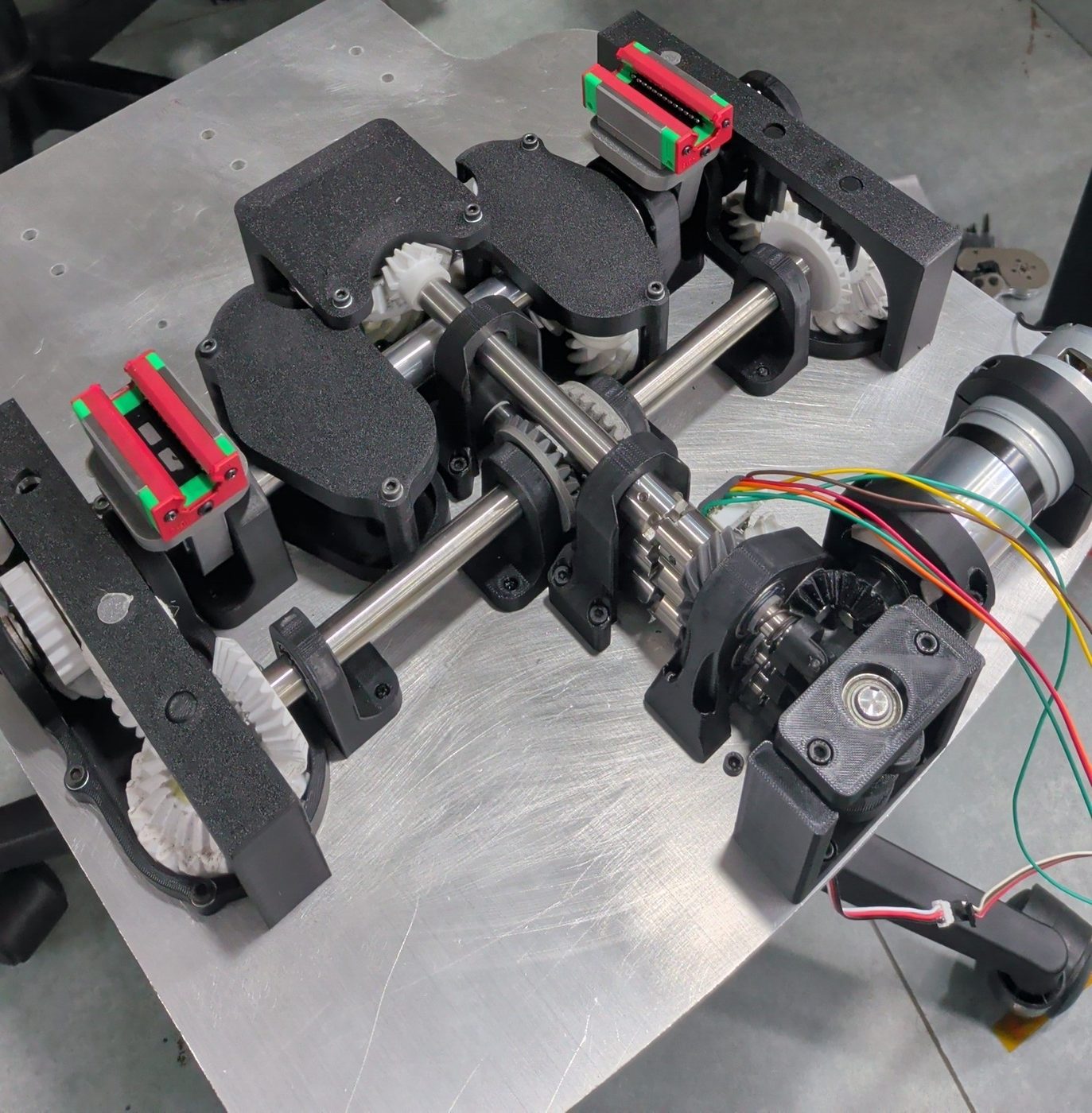
One motor is serial. Many joints are parallel demands. The catalogue answer, one actuator per joint, builds a fleet that is idle almost always and paid for always. Ours is mechanical multiplexing: one power motor time-shared across every joint through a selector, with self-locking joints that hold at zero power once disengaged. At any moment the action space is a selection and an effort, whatever the joint count, and holding never appears in it. Flow's 15 degrees of freedom run on six motors today, four in the revision underway, two at the architectural limit: one that powers, one that selects. At the limit, a new degree of freedom costs a joint and a link, not a motor and a driver. Cama's 46 will follow the same arithmetic, after Flow. The full argument, and why the way forward is a faster selector, not more motors, is in that article.
Mechanism
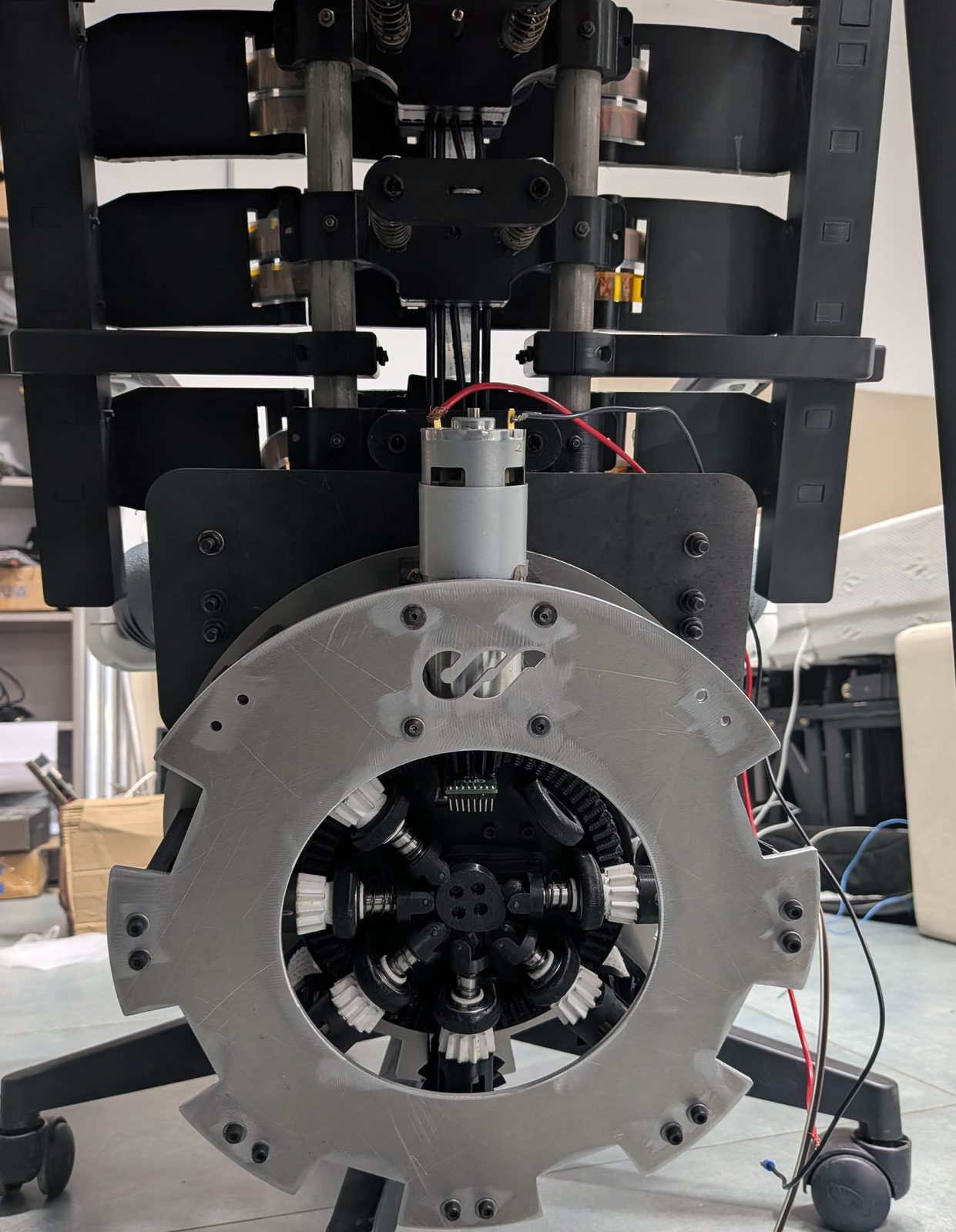
The mechanism is the layer the person touches: where an axis sits decides what a unit of torque does to a body. A reclining torso rotates about an axis through the hip, inside the person, where no bearing can go. Our first answer, an eight-link chain placing its centre of rotation exactly on the hip axis, is worked out in the reclining article. It did its job and froze one belief into steel: recline means rotation about one fixed axis.
The seat in the current Flow makes the opposite bet: a platform the model commands directly. A hip pivot is now one motion among many the seat can produce, for this body, at this moment, not its only one. The linkage crystallised an answer. The platform crystallises the ability to move and hold, and leaves the answer to the model. Recline became customisable: one point in the action space, not the whole of it.
The platform answers a question live across the rest of the machine: should a mechanism mirror the body's kinematics, or deviate? Mirroring is easy to reason about and easy to explain to a clinician. Deviating can buy force, footprint, or a simpler action space, so long as motion where machine meets person stays anatomically correct. We answer region by region: prototypes tested on ourselves, because here the researchers fit inside the test fixture, checked with neurologists, orthopaedic surgeons, and physiotherapists, because the kinematics that matter are written down nowhere. Each answer will get its article when it earns one.
Upstream
Upstream, off-the-shelf DC motors and reducers turn stored energy into shaft power, and for now that is the whole story. The conversion this regime wants, high torque near zero speed, built for holds and silence, waits until the layers downstream fix its specification.
Where this leaves us
Three questions stay open. How fast can a selector get before time-sharing stops being a compromise? Which motions will a seat turn out to need that no fixed linkage would have offered? And how much of this survives outside the quasi-static regime? We are building toward the first two. The third we mostly try not to think about, and fail.
Intelligence is compounding toward abundance. The physics it acts through is not. Mechanical invention never stopped, new hands and new actuators prove that, but it has been the exception in a field that mostly builds from the catalogue. We think the exception is about to become the rule, and the mechatronics team at Water will be at the forefront of it.